
Employee Welfare Fund vs Provident Fund: What Are the Key Differences?
A practical comparison of Thailand’s Employee Welfare Fund (EWF) and Provident Fund (PVD), including contribution rates, coverage considerations, and key actions employers, HR teams, and Payroll functions should prepare for before 1 October 2026.
Understand the Differences in One Article
From 1 October 2026, contributions to the Employee Welfare Fund will begin for employers and employees who fall within the scope of the applicable legal requirements. As a result, many businesses are asking whether companies that already have a Provident Fund still need to consider the Employee Welfare Fund.
Article Contents
- What is the Employee Welfare Fund?
- What is a Provident Fund?
- Key differences between EWF and PVD
- How much must be contributed to the EWF?
- If a company already has a PVD, is EWF still relevant?
- What if some employees are not PVD members?
- How do the purposes of EWF and PVD differ?
- What should employers, HR, and Payroll prepare?
- Frequently asked questions
What is the Employee Welfare Fund?
The Employee Welfare Fund (EWF) is a statutory fund established under Thailand’s labour protection framework. Its purpose is to provide employees with a basic level of financial security by requiring eligible employers and employees to make contributions in accordance with the rates and conditions prescribed by law.
Under the new implementation framework, particular attention should be given to establishments with 10 or more employees that do not otherwise provide employees with qualifying welfare arrangements or fall within an applicable exemption.
When employment ends and the applicable conditions are met, the employee may become entitled to the accumulated employee contributions, employer contributions, and related benefits in accordance with the rules of the fund.
What is a Provident Fund?
A Provident Fund (PVD) is an employee benefit arrangement jointly established by an employer and employees to support long-term savings and financial security upon resignation, retirement, or other qualifying events.
A Provident Fund generally consists of:
- Employee contributions deducted from the employee’s salary
- Employer contributions paid in addition to the employee’s contribution
- Investment returns generated by the fund
Provident Fund assets are managed and invested in accordance with the fund’s investment policy, applicable regulations, and the rules of the relevant fund.
Employee Welfare Fund vs Provident Fund: What Are the Differences?
Although both arrangements involve contributions from employers and employees, their legal structure, objectives, contribution mechanisms, and level of flexibility differ significantly.
| Topic | Employee Welfare Fund (EWF) | Provident Fund (PVD) |
|---|---|---|
| Primary purpose | Provide basic financial protection to employees under labour law | Promote long-term savings and retirement readiness |
| Nature of arrangement | Statutory fund for establishments and employees that fall within the legal criteria | Fund established by agreement between employer and employees |
| Main legal framework | Labour Protection Act | Provident Fund Act |
| Participation | Mandatory where the legal criteria apply | Subject to fund establishment and fund rules |
| Employee payment | Employee contribution at the statutory rate | Employee contribution in accordance with the fund rules |
| Employer payment | Employer contribution at the statutory rate | Employer contribution in accordance with the fund rules |
| Initial contribution rate | Employee 0.25% + Employer 0.25% | Varies depending on each fund’s rules |
| Investment structure | Managed within the statutory EWF framework | Assets are professionally managed and invested through fund managers |
| Savings objective | Basic financial protection upon termination of employment | Long-term wealth accumulation and retirement preparation |
| Flexibility | Primarily determined by law and statutory criteria | Greater flexibility under the fund rules and investment policy |
How Much Must Be Contributed to the Employee Welfare Fund?
The contribution rates are divided into two phases.
| Period | Employee | Employer | Total |
|---|---|---|---|
| 1 Oct 2026 – 30 Sep 2031 | 0.25% | 0.25% | 0.50% |
| From 1 Oct 2031 onwards | 0.50% | 0.50% | 1.00% |
Example Calculation
Assume an employee earns THB 30,000 per month during the period from 1 October 2026 to 30 September 2031.
If a Company Already Has a Provident Fund, Is the Employee Welfare Fund Still Relevant?
This is one of the most important questions for employers, HR teams, and Payroll functions.
If a company has already established a Provident Fund, it should still review which employees are PVD members and which employees are not, while also considering the applicable statutory criteria and exemptions.
“Our company already has a Provident Fund, therefore the Employee Welfare Fund does not apply to us at all.”
In practice, the analysis should be carried out at employee level and should take into account the company’s PVD rules as well as the legal conditions applicable to the Employee Welfare Fund.
What If the Company Has a PVD but Some Employees Are Not Members?
This is an important area for HR and Payroll teams to review because having a Provident Fund at company level does not automatically mean that every employee is a member.
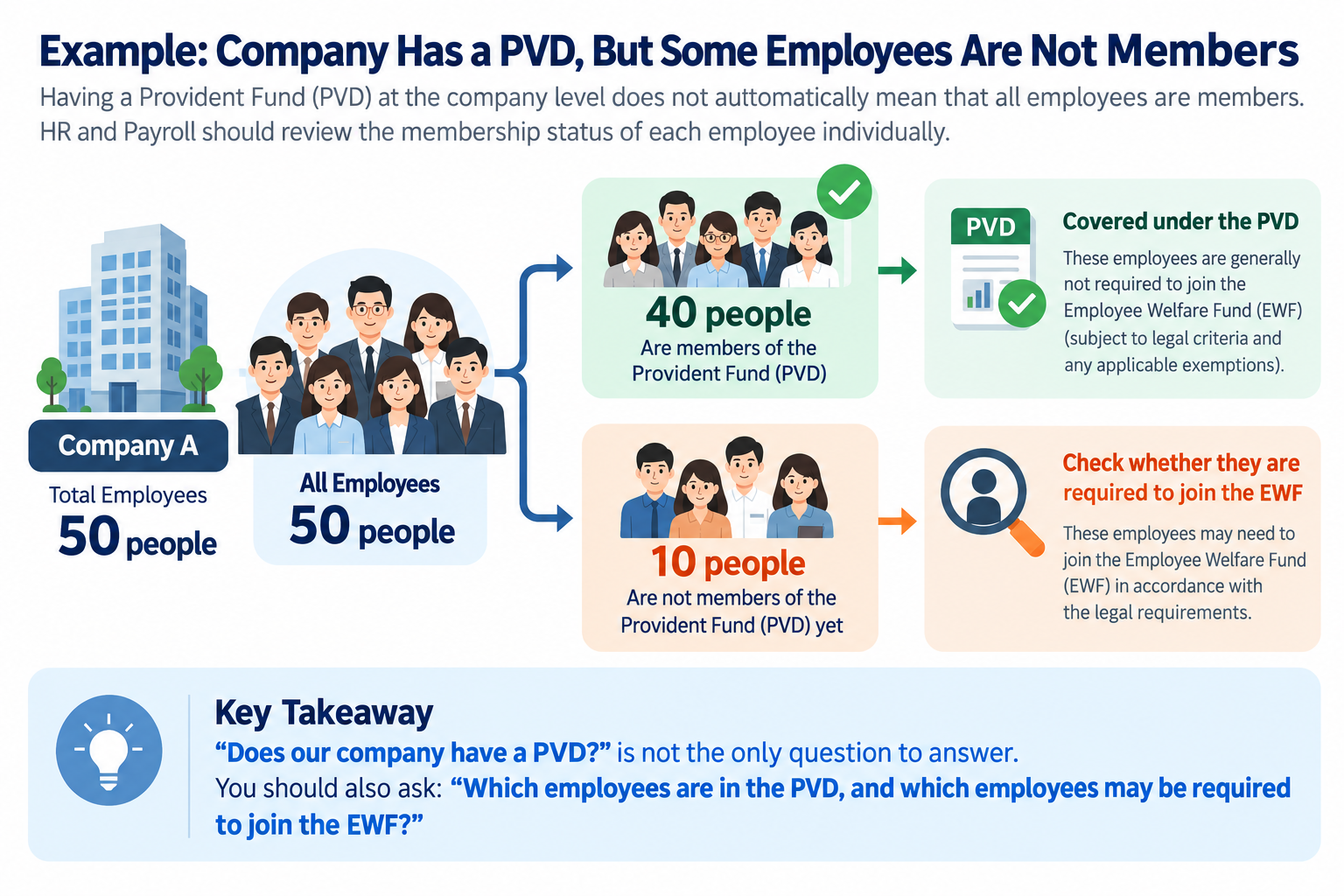
Example of an employee-level review where the company has a Provident Fund but some employees are not yet PVD members.
Example
Company A has a total of 50 employees.
There may be several reasons why these 10 employees are not yet PVD members, for example because they have not yet satisfied the eligibility conditions under the company’s fund rules or are otherwise not currently covered by the PVD arrangement.
The key question is therefore not simply “Does the company have a PVD?” but rather “Which employees are already covered under the PVD, and which employees may need to be considered for EWF coverage?”
EWF and PVD Both Involve Contributions, but Their Purposes Are Different
From a Payroll and compensation management perspective, the difference becomes clearer when comparing the contribution amounts.
Employee Welfare Fund (EWF)
Assume monthly wages of THB 30,000 using the initial contribution rate.
Provident Fund (PVD)
Assume the fund rules specify a contribution rate of 5%.
This illustrates the fundamental difference in design: a PVD is primarily focused on long-term savings, whereas the Employee Welfare Fund operates as a statutory baseline of financial protection.
What Should Employers, HR, and Payroll Prepare Before 1 October 2026?
Preparation should involve more than simply adding a 0.25% deduction formula to the Payroll system. Before any calculation is made, the company should first determine which employees fall within the scope of the Employee Welfare Fund.
HR / Payroll Readiness Checklist
-
Review the number of employees
Confirm whether the establishment falls within the relevant statutory threshold. -
Review the company’s Provident Fund arrangement
If a PVD is already in place, review the fund rules and employee membership status. -
Separate PVD members and non-members
Identify employees who may need to be assessed under the Employee Welfare Fund rules. -
Review the wage base used for calculation
Confirm the wage components and related items used to calculate employee and employer contributions. -
Update the Payroll system
Add the employee contribution and employer contribution items, and review related reports and payslips. -
Review registration and remittance procedures
Understand the process and channels prescribed by the relevant authorities. -
Communicate with employees in advance
Because employee contributions affect net pay, employees should be informed before deductions begin.
Why Is the Employee Welfare Fund Directly Relevant to Payroll?
The Employee Welfare Fund is not only an HR or legal compliance matter. It directly affects the Payroll process, from employee eligibility review through to contribution calculation and remittance.
Payroll-related processes include:
- Reviewing employees who fall within the applicable scope
- Reviewing the wage base
- Calculating employee contributions
- Calculating employer contributions
- Displaying deductions in Payroll and on payslips
- Reconciling contribution amounts before remittance
- Preparing data for statutory submission and payment
Frequently Asked Questions: Employee Welfare Fund and Provident Fund
When does the Employee Welfare Fund contribution start?
Collection of employee and employer contributions is scheduled to begin on 1 October 2026.
What percentage will be deducted from employees?
From 1 October 2026 to 30 September 2031, employees contribute 0.25% and employers contribute 0.25% of wages.
From 1 October 2031 onwards, the rate increases to 0.50% for each party.
Does a company with fewer than 10 employees need to join?
The implementation framework is primarily focused on establishments with 10 or more employees. Employers should nevertheless consider the applicable statutory criteria and exemptions when assessing their obligations.
If the company already has a PVD, does it still need to consider the EWF?
The company should review employee status on an individual basis to determine whether each employee is already covered under the PVD or another qualifying arrangement, particularly where some employees are not yet PVD members.
Do employees pay the full EWF contribution themselves?
No. During the initial period, the employee contributes 0.25% and the employer contributes an additional 0.25% of wages.
Is the Employee Welfare Fund the same as Social Security?
No. Although both systems involve employee deductions and employer contributions, they are separate arrangements with different purposes, legal frameworks, benefits, and operating rules.
Conclusion
The Employee Welfare Fund and Provident Fund are not the same arrangement.
A Provident Fund is primarily designed to support long-term employee savings and investment, while the Employee Welfare Fund serves as a statutory mechanism intended to provide a basic layer of financial protection for employees who fall within the applicable legal criteria.
“Does our company have a PVD?”
The more important question is:
“Which employees are covered by the PVD, and which employees may fall within the scope of the Employee Welfare Fund?”
With EWF contributions scheduled to begin on 1 October 2026, HR and Payroll teams should review employee records, wage bases, Payroll configuration, registration requirements, and contribution procedures in advance.
Need Professional Support to Manage Payroll Accurately and Efficiently?
AIMSUCCESS provides Payroll Outsourcing services for businesses, covering employee data processing, Payroll calculations, personal income tax, Social Security, employee funds, Payroll reports, and related documentation.
Our services are designed for organizations seeking to reduce HR workload, improve Payroll continuity, and minimize the risk of calculation and compliance errors.
References: Department of Labour Protection and Welfare / Securities and Exchange Commission, Thailand / Applicable laws and regulations relating to the Employee Welfare Fund and Provident Fund

